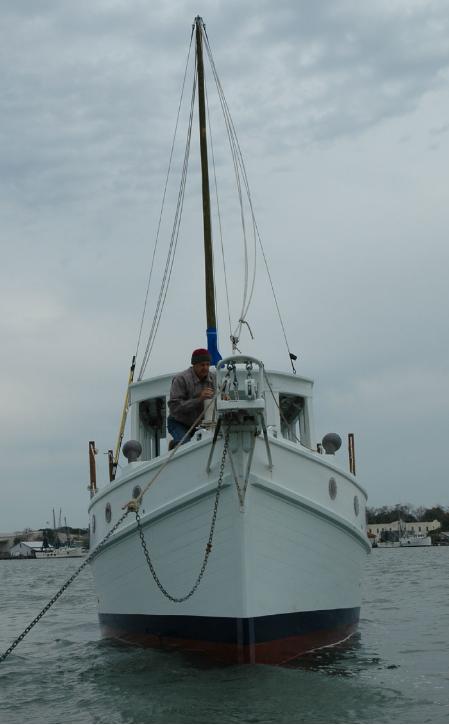
Briney Bug’s slim shape—her beam is 12 feet—allows the displacement hull to be easily driven.
What about hull design?
Speed requires horsepower, horsepower requires fuel, and fuel requires money; facts that all cruisers have to face. For the most economical cruising, having a hull shape that uses the least amount of fuel is the first key to low-cost cruising under power.
Any hull will require a certain amount of horsepower to achieve a particular speed, but a full displacement hull requires the least amount of horsepower than any other hull type, all other factors being the same, and this type of hull also tends to have more storage.
Though a displacement hull is limited in speed compared to other types, it is offset by being more sea-kindly, and for these reasons, we felt a displacement hull better suited our needs.
Editor’s note: Rudy and Jill Sechez, when they are not away cruising, live aboard Briney Bug in Port St. Joe, Florida, and provide boat and yacht repair services. They can be reached at 850-832-7748 or via e-mail by clicking here.
Trawlers & Trawlering and its abbreviation T&T, I'd Rather Be Trawlering, Passagemaking Under Power and its abbreviation PUP, Trawler Buy-Sell-Trade, Trawler News, Circumnavigator, and Power Catamaran World are trademarks of Water World Productions.