 |
|
 |
|
 |
||
|
|
|
 |
 |
 |
|||
|
|
|
|
|
|
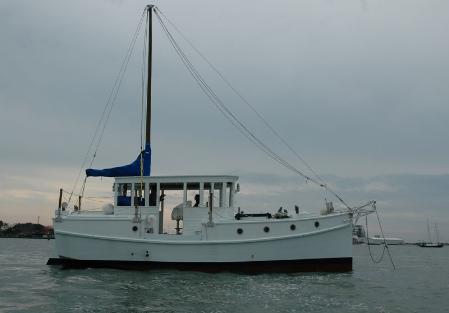
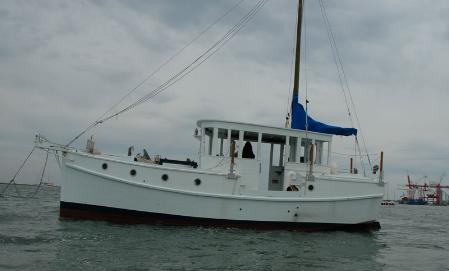
What does Briney Bug look like? Briney Bug is 34 feet long, has a 12-foot beam, a 4-foot 9-inch draft, weighs 29,000 pounds, has a full keel, a plumb stem, hard chines, a deck level pilothouse and a raised sheer fore and aft. The main salon and galley is forward, the engine room (with a pilothouse above) is mid-ship, and aft is the sleeping quarters wherein is located a head, shower, storage and a 5-foot by 7-foot bed. Other details include 200 gallons of fuel, 100 gallons of water, a 25-gallon gravity-drained holding tank, 25 gallons of kerosene, a diesel engine, an assist/emergency sailing rig, hard dinghy storage on the fore deck, and of course, the proverbial wooden bucket. The hull is carvel planked over sawn frames; all structural members and planking are pressure treated pine with the most difficult to replace timbers being the heaviest treated (2.5 lbs/cu. ft.), while the planking is treated to a lesser degree (.4 lbs/cu. ft.). With the exception of the stainless steel ballast bolts, the hull is fastened with galvanized fasteners. There are about 4,000 pounds of lead ballast. The interior is varnished cypress, fastened with bronze fasteners. —Rudy and Jill Sechez
Here’s how the Briney Bug story is presented: What does Briney Bug look like? Editor’s note: Rudy and Jill Sechez, when they are not away cruising, live aboard Briney Bug in Port St. Joe, Florida, and provide boat and yacht repair services. They can be reached at 850-832-7748 or via e-mail by clicking here. |
||||||||
Simplicity taken to the max |
||||||||
|
||||||||
 |
||||||||
|
||||||||
|
|
|
|
|
|
|
|
|
 |
||
|
|
|
Stay informed with Trawler News from Trawlers & Trawlering! |
||
|
|
|
Name: |
E-mail: |
|||||||
|
|
|
|
|
|
|
|
|
|
|
|
|
|
 |
|
|
|
© 1997-2014 Water World Productions, formerly Trawler World Productions. All rights reserved. Reproduction of material from any trawlersandtrawlering.com page without written permission is strictly prohibited. Any copyrighted images remain the property of the copyright owner and are believed to be used with permission. Unsolicited letters, e-mails, articles and other materials submitted to us may be published, distributed and stored by Water World Productions and its assignees in whole or in part, in print or by any other means, including but not limited to electronic, and may be edited for clarity and space. Trawlers & Trawlering and its abbreviation T&T, I'd Rather Be Trawlering, Passagemaking Under Power and its abbreviation PUP, Trawler Buy-Sell-Trade, Trawler News, Circumnavigator, and Power Catamaran World are trademarks of Water World Productions.
|
||
|
|
|
