 |
|
 |
|
 |
||
|
|
|
 |
 |
 |
|||
|
|
|
|
|
|
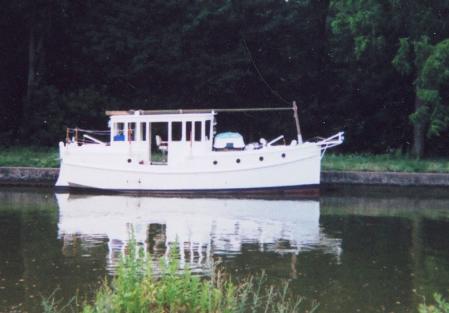
Why do you have a sailing rig? The purpose of a sailing rig on a power cruiser is to help the boat go faster, use less fuel, improve its motion, allow for emergency propulsion and perform as a cargo hoist. As mentioned, it is one of the lowest tech systems for emergency propulsion that we know of, and this is the system that we installed on Briney Bug. Even though a powerboat can travel up into the wind, whereas a sailboat is more limited in doing so, it becomes too uncomfortable for either, so passages, especially ocean passages, are planned to go with the wind, not to fight it. As a power cruiser will not be sailing up into the wind, its sailing rig can be smaller, simpler and less expensive. On Briney Bug, the mast is 25 feet long, the boom is 7 feet long (at one time both were cypress trees growing beside the boat shop). The jib is 183 sq. ft., the mainsail 80 sq. ft. and both have reef points. There are two stays and two shrouds, both with spliced eyes, four turnbuckles (dead-eyes could be used), two halyards, two sheets, and a few blocks. The mast is in a tabernacle and is rigged to be easily lowered in minutes by one person. Off the forward side of the mast is a boom that is used to hoist the dinghy on and off, and is hefty enough that it can be rigged and swung out to reduce rolling while at anchor. To keep the end of the boom from interfering, when not in use, we made the outer four feet of the boom removable. This portion of the cargo boom which is removable, stows up in the pilot house beams along with our oars and the boat pole. As an assist to the engine, in all but the lightest of air, our jib allows us to gain an additional knot of speed. This system is inexpensive and has performed admirably on Briney Bug. Our thanks goes out to George Buehler for planting this seed in our minds. —Rudy and Jill Sechez Here’s how the Briney Bug story is presented: What does Briney Bug look like? Editor’s note: Rudy and Jill Sechez, when they are not away cruising, live aboard Briney Bug in Port St. Joe, Florida, and provide boat and yacht repair services. They can be reached at 850-832-7748 or via e-mail by clicking here. |
||||||||
Simplicity taken to the max |
||||||||
|
||||||||
 |
||||||||
|
||||||||
|
|
|
|
|
|
|
|
|
 |
||
|
|
|
Stay informed with Trawler News from Trawlers & Trawlering! |
||
|
|
|
Name: |
E-mail: |
|||||||
|
|
|
|
|
|
|
|
|
|
|
|
|
|
 |
|
|
|
© 1997-2014 Water World Productions, formerly Trawler World Productions. All rights reserved. Reproduction of material from any trawlersandtrawlering.com page without written permission is strictly prohibited. Any copyrighted images remain the property of the copyright owner and are believed to be used with permission. Unsolicited letters, e-mails, articles and other materials submitted to us may be published, distributed and stored by Water World Productions and its assignees in whole or in part, in print or by any other means, including but not limited to electronic, and may be edited for clarity and space. Trawlers & Trawlering and its abbreviation T&T, I'd Rather Be Trawlering, Passagemaking Under Power and its abbreviation PUP, Trawler Buy-Sell-Trade, Trawler News, Circumnavigator, and Power Catamaran World are trademarks of Water World Productions.
|
||
|
|
|
