 |
|
 |
|
 |
||
|
|
|
 |
 |
 |
|||
|
|
|
|
|
|
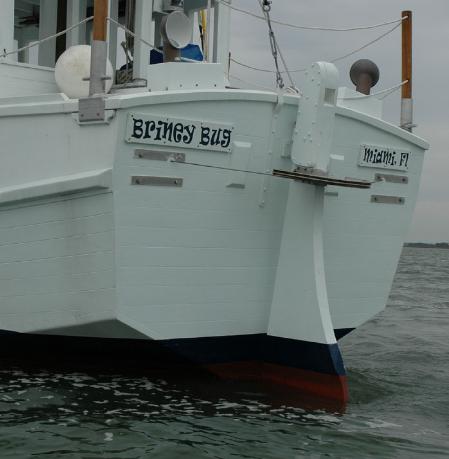
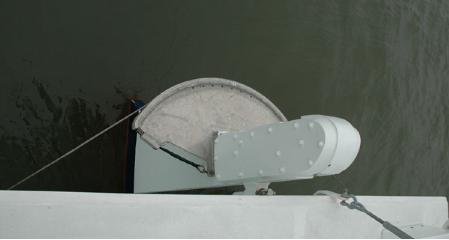
What’s with the big rudder? If sails are to be used, or for low speed maneuvering, the size of the rudder needs to be considered. The rudder needs to be larger than a typical powerboat's rudder, especially if the prop will not be providing the necessary water flow for small rudders to be effective. This is particularly important when the sails are used for emergency propulsion. This is why the Bug has a large rudder, with the underwater portion of the rudder being about 2 feet wide and 4 feet, 3 inches long. Being transom hung made the ruder inexpensive to build, easy to install, and easy to maintain. An aft-facing quadrant operated by wire that is connected to pedestal steering was simple and inexpensive to install, and since every inch of it is accessible, it is easily inspected. A tiller can be shipped for emergencies, in the unlikely event that the steering fails. —Rudy and Jill Sechez
Here’s how the Briney Bug story is presented: What does Briney Bug look like? Editor’s note: Rudy and Jill Sechez, when they are not away cruising, live aboard Briney Bug in Port St. Joe, Florida, and provide boat and yacht repair services. They can be reached at 850-832-7748 or via e-mail by clicking here. |
||||||||
Simplicity taken to the max |
||||||||
|
||||||||
 |
||||||||
|
||||||||
|
|
|
|
|
|
|
|
|
 |
||
|
|
|
Stay informed with Trawler News from Trawlers & Trawlering! |
||
|
|
|
Name: |
E-mail: |
|||||||
|
|
|
|
|
|
|
|
|
|
|
|
|
|
 |
|
|
|
© 1997-2014 Water World Productions, formerly Trawler World Productions. All rights reserved. Reproduction of material from any trawlersandtrawlering.com page without written permission is strictly prohibited. Any copyrighted images remain the property of the copyright owner and are believed to be used with permission. Unsolicited letters, e-mails, articles and other materials submitted to us may be published, distributed and stored by Water World Productions and its assignees in whole or in part, in print or by any other means, including but not limited to electronic, and may be edited for clarity and space. Trawlers & Trawlering and its abbreviation T&T, I'd Rather Be Trawlering, Passagemaking Under Power and its abbreviation PUP, Trawler Buy-Sell-Trade, Trawler News, Circumnavigator, and Power Catamaran World are trademarks of Water World Productions.
|
||
|
|
|
